Energy-control system · 07

New & Renewable Energy

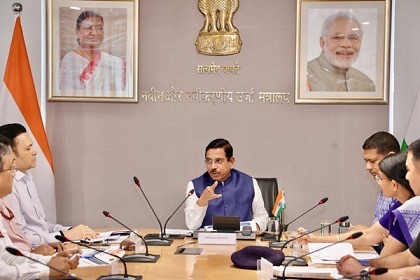
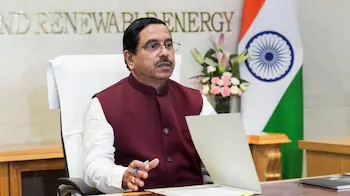
The Ministry of New and Renewable Energy (MNRE) is responsible for solar, wind, small hydro, bio-energy and green hydrogen. Pralhad Joshi has been its Union Minister since June 2024; Shripad Yesso Naik is Minister of State. Capacity is built largely by developers selected through tenders run by implementing agencies, so the figures here are sector outcomes as reported by MNRE and the Central Electricity Authority.

Official dataOfficial statement
Installed capacity · IndiaAs on 31.08.2026
Solar168.04 GW
Wind58.52 GW
Large hydro52.06 GW
Bio-power11.75 GW
Nuclear8.78 GW
Small hydro5.18 GW
304.33 GWNon-fossil capacity
295.55 GWRenewable, incl. large hydro
554.54 GWAll-India installed capacity

CH-01

Solar Energy

Official dataDocumented fact

Installed solar capacity was 168.04 GW as on 31 August 2026: 123.99 GW ground-mounted, 32.59 GW grid-connected rooftop, 4.83 GW in hybrid projects and 6.63 GW off-grid. In FY 2025-26 the Ministry reported a record 44.61 GW of solar additions.

PM Surya Ghar: Muft Bijli Yojana, launched in February 2024 with an outlay of ₹75,021 crore, aims to put rooftop solar on one crore households. On 4 August 2026 the Ministry reported over 50.06 lakh households benefiting and ₹28,024 crore of subsidy released through direct benefit transfer. Under PM-KUSUM, farmers install solar pumps and solarise existing ones. In September 2026 he stated that about 29 lakh pumps had been solarised and that the next phase would include an agrivoltaics component.

168.04 GWSolar capacity, 31 Aug 2026
32.59 GWGrid-connected rooftop
50.06 lakhHouseholds benefiting, PM Surya Ghar
₹28,024 crSubsidy released via DBT
“PM Suryaghar Muft Bijli Yojana is creating one of the world’s largest residential solar markets while advancing India’s clean energy transition and energy self-reliance,”
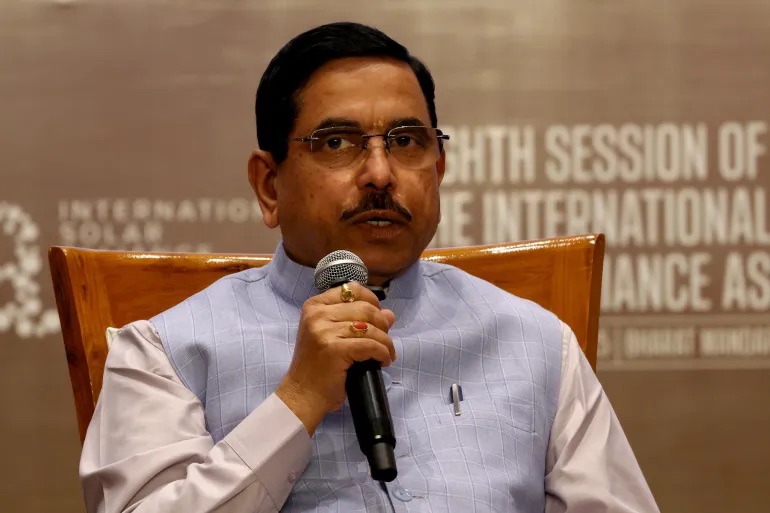
Verified quotation · 4 June 2026 (PIB)

CH-02

Wind Energy

Official dataDocumented fact

Installed wind capacity was 58.52 GW as on 31 August 2026. On Global Wind Day 2026 in Goa the Ministry stated targets of 100 GW of wind by 2030 and 156 GW by 2036, and launched WT-MARUT, a portal for the wind-turbine supply chain.

On 19 June 2024 the Union Cabinet approved viability gap funding of ₹7,453 crore for offshore wind. The amount includes ₹6,853 crore for 1 GW of projects off Gujarat and Tamil Nadu and ₹600 crore for upgrading two ports. In June 2025 he stated that 4 GW of offshore leasing areas had been identified.

58.52 GWWind capacity, 31 Aug 2026
100 GWWind target, 2030
₹7,453 crOffshore wind VGF
“Our national goals are ambitious and clear: 50% of our power capacity from non-fossil fuel sources by 2030, and a net-zero India by 2070. Wind energy is central to achieving these goals. Wind energy is not a component of our renewable energy strategy but it is at the heart of it and at the centre of Atma Nirbhar Bharat,”
Verified quotation · Global Wind Day, Bengaluru, 15 June 2025 (PIB)

CH-03

Floating Solar

Documented factOfficial data

On 10 June 2026 he released a report by the National Institute of Solar Energy (NISE) assessing over 102 GWp of floating solar potential on India’s water bodies, which takes the total assessed solar potential to 3,445 GWp. On 31 July 2026 the Union Cabinet approved the Pradhan Mantri Surya Sarovar Yojana: ₹5,070 crore for 5,000 MW of floating solar, each project paired with at least two hours of storage, with sanctions from FY 2026-27 to FY 2030-31. Existing floating solar capacity was put at about 700 MW.

102 GWpAssessed floating solar potential
₹5,070 crPM Surya Sarovar Yojana outlay
5,000 MWFloating solar to be supported

CH-04

Small Hydro

Documented factOfficial data

Small hydro covers projects of up to 25 MW, and installed capacity was 5.18 GW on 31 August 2026. The Cabinet approved the Small Hydro Power Development Scheme for FY 2026-27 to FY 2030-31, with an outlay of ₹2,584.60 crore for about 1,500 MW. It covers projects of 1–25 MW and focuses on hilly and North Eastern States. He launched the scheme’s online portal on 10 June 2026; PIB described the scheme as the first major policy intervention in the sector since 2017.

5.18 GWSmall hydro capacity, 31 Aug 2026
₹2,584.60 crSHP Development Scheme outlay
~1,500 MWCapacity targeted

CH-05

Green Energy & Hydrogen

Documented factOfficial data

The National Green Hydrogen Mission has an outlay of ₹19,744 crore to 2029-30 and aims for at least 5 million tonnes a year of green hydrogen production by 2030. Under its SIGHT programme, incentives have been awarded for 8,62,000 tonnes a year of green hydrogen production and 3,000 MW a year of electrolyser manufacturing. He launched the Green Hydrogen Certification Portal on 17 June 2026.

₹19,744 crNGHM outlay
5 MMTAnnual production target, 2030
8.62 LMT/yrGreen hydrogen awarded under SIGHT
“Today is a historic day as we mark the first-ever agreement for the supply of Green Ammonia from India to Japan. This agreement will help establish a robust supply chain from production in India to consumption in Japan, paving the way for future collaborations in the green energy sector.”
Verified quotation · India–Japan green ammonia agreement, 20 August 2024 (PIB)

CH-06

Renewable Manufacturing

Official dataDocumented fact

The Ministry reported that domestic solar module manufacturing capacity grew from 2.3 GW in 2014 to 192 GW by June 2026, and cell capacity from 1.2 GW to 30 GW. In August 2026 enlisted module capacity under the Approved List of Models and Manufacturers (ALMM) crossed 200 GW. ALMM List-II for solar cells applies to projects commissioned from 1 June 2026; net-metering and open-access projects have until 31 December 2026. The PLI scheme for high-efficiency modules has an outlay of ₹24,000 crore, and wind-turbine manufacturing capacity was about 24 GW in March 2026.

2.3 → 192 GWModule capacity, 2014 → Jun 2026
1.2 → 30 GWCell capacity, 2014 → Jun 2026
~24 GWWind turbine manufacturing
“Aatmanirbharta is not about isolation; it is about confidence, capability and global competitiveness,”
Verified quotation · CII summit, 12 May 2026 (PIB)

CH-07

Energy Transition

Official dataOfficial statement

India’s target, announced at COP26, is 500 GW of non-fossil capacity by 2030. The Ministry reported that non-fossil sources reached 50 per cent of installed capacity in June 2025, five years ahead of the 2030 NDC target, and crossed 300 GW on 31 July 2026. The Central Electricity Authority recorded 304.33 GW of non-fossil capacity (54.88 per cent) as on 31 August 2026. Per IRENA’s 2026 statistics, as cited by the Ministry, India ranks third in the world in total installed renewable capacity. FY 2025-26 saw a record 55.29 GW of non-fossil additions.

304.33 GWNon-fossil capacity, 31 Aug 2026
55.29 GWNon-fossil added, FY 2025-26
500 GW2030 target
“In a world seeking climate solutions, India is showing the way. Achieving 50% non-fossil fuel capacity five years ahead of the 2030 target is a proud moment for every Indian. Prime Minister Shri Narendra Modi’s leadership continues to drive Bharat’s green transformation — paving the path towards a self-reliant and sustainable future.”
Verified quotation · 14 July 2025 (PIB)

CH-08

Clean Technology

Documented factOfficial statement

Storage is central to integrating variable solar and wind power. Viability gap funding for battery energy storage is a Ministry of Power scheme, and he has spoken about its expansion. He opened a 5 GWh battery manufacturing plant at Bidadi, Karnataka, in June 2025. In March 2025 he flagged off India’s first trials of hydrogen-powered trucks.

“Modi government is planning to roll out an additional ₹5,400 crore as viability gap funding to support the setting up of 30 GWh of battery storage systems. This is over and above the ₹3,700 crore already being given under the existing VGF scheme, through which 13.2 GWh of BESS projects are already being implemented.”
Verified quotation · 27 June 2025 (PIB)

CH-09

Investment

Official dataDocumented fact

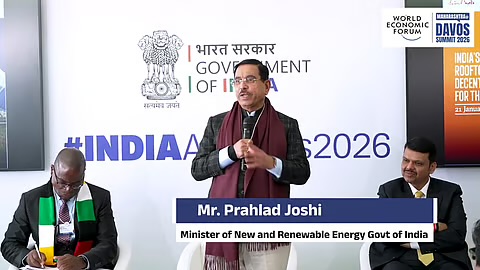
The fourth Global Renewable Energy Investors’ Meet and Expo (RE-INVEST 2024), held at Gandhinagar on 16–18 September 2024, recorded commitments worth ₹32.45 lakh crore. States committed 540 GW by 2030, developers 570 GW, and manufacturers 340 GW of modules and 240 GW of cells. At the World Economic Forum in Davos in January 2026, he cited a financing requirement of about USD 300–350 billion to reach 500 GW.

₹32.45 lakh crRE-INVEST 2024 commitments
540 GWState commitments by 2030
USD 300–350 bnFinancing need cited for 500 GW

CH-10

Research & Innovation

Documented fact

NISE has published national resource assessments: 3,343 GW of feasible ground-mounted solar potential (September 2025) and over 102 GWp of floating solar potential (June 2026). Under the Green Hydrogen Mission, the Ministry announced a ₹100 crore call for proposals for start-ups in September 2025 and a ₹100 crore call for biomass-based hydrogen pilots in November 2025. The 7th Agrivoltaics World Conference is scheduled for 21–23 October 2026.

CH-11

Grid Integration

Documented factOfficial data

Renewable power needs transmission from resource-rich areas to demand centres. The Ministry reported that seven States have completed Phase I of the Green Energy Corridor, that about ₹787 crore was released in 2025-26, and that about 345 GW of renewable energy zones have been declared beyond the 500 GW transmission plan. The next phase is being planned.

7States completed GEC Phase I
~345 GWAdditional RE zones declared

12 Documented engagements

Renewable energy in the record

Recent official releases naming the Minister. Full archive · Statements

  1. PIB

    Curtain raiser for the 7th Agrivoltaics World Conference

    Described the farmer as becoming an “Urjadata” as well as an “Annadata”; stated that about 29 lakh pumps had been solarised under PM-KUSUM and that the next phase would include an agrivoltaics component.

    Source

    Renewable Energy · Food & Public Distribution · Public Events

  2. PIB

    Non-fossil capacity crosses 300 GW

    The Ministry reported 300.50 GW of non-fossil capacity as of 31 July 2026, over 54 per cent of total installed capacity.

    Source

    Renewable Energy

  3. PIB

    PM Surya Ghar: over 50 lakh households benefiting

    The Ministry reported over 50.06 lakh households benefiting and ₹28,024 crore of subsidy released through direct benefit transfer.

    Source

    Renewable Energy

  4. PIB

    Bharat Renewable Energy Summit & Expo 2026 announced

    Announced that the Summit, the 9th ISA Assembly and the 4th ICGH would be held together in New Delhi from 2 to 5 November 2026.

    Source

    Renewable Energy · Public Events

  5. PIB

    Green Hydrogen Certification Portal launched

    The release also reported SIGHT incentives awarded for 8,62,000 MTPA of green hydrogen production.

    Source

    Renewable Energy · Policy

  6. PIB

    Global Wind Day 2026: first wind supply chain portal launched

    Launched the WT-MARUT portal in Goa; the Ministry stated targets of 100 GW of wind by 2030 and 156 GW by 2036.

    Source

    Renewable Energy · Public Events

  7. PIB

    Over 102 GWp of floating solar potential assessed; small hydro portal launched

    Released the NISE report assessing over 102 GWp of floating solar potential and launched the online portal for the Small Hydro Power Development Scheme.

    Source

    Renewable Energy · Policy

  8. PIB

    75 lakh households targeted for rooftop solar by December 2026

    Stated that PM Surya Ghar had over 1 crore registrations, with over 33 lakh systems installed as of May 2026.

    Source

    Renewable Energy · Statements

  9. PIB

    CII summit: clean energy anchored in Aatmanirbharta

    Spoke on self-reliance in clean energy manufacturing.

    Source

    Renewable Energy · Statements

  10. PIB

    FY 2025-26 review: India ranks third globally in renewable capacity

    The Ministry reported a record 55.29 GW of non-fossil capacity added in FY 2025-26 and 283.46 GW installed as of 31 March 2026.

    Source

    Renewable Energy