India’s food system connects the farmer who sells grain at the minimum support price to the household that draws it free at a fair price shop. The Department of Food and Public Distribution, headed since June 2024 by Union Minister Pralhad Joshi, oversees procurement, storage, allocation and reform of the public distribution system. States carry out last-mile distribution.
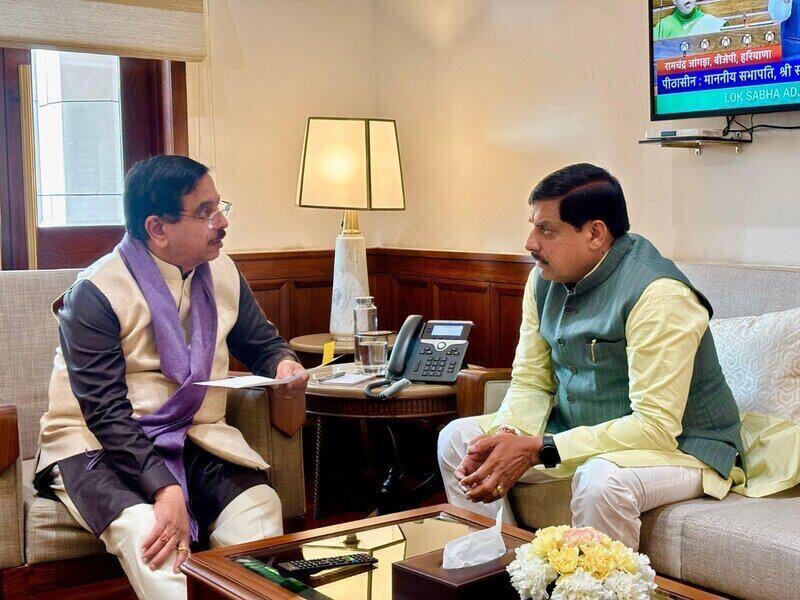
With Madhya Pradesh Chief Minister Dr Mohan Yadav at Parliament, 4 February 2026. ANI reported that they discussed rice procurement, lifting of stocks and storage capacity.ANI
Procurement at MSP supports farm incomes and builds the central pool from which all food-security entitlements are met.
Documented factOfficial data
Procurement
Wheat and paddy are procured at minimum support prices by the Food Corporation of India and State agencies. The Department reported 300.35 LMT of wheat procured in RMS 2025-26 from 25,13,143 farmers, and 832.17 LMT of paddy in KMS 2024-25 from over 1.18 crore farmers. The wheat procurement estimate for RMS 2026-27 was fixed at 303 LMT on 6 March 2026.
The central pool holds wheat and rice for NFSA, other welfare schemes and market intervention. The allocation for 2025-26 was 608.16 LMT. A news report citing government data put central stocks at 604.02 LMT on 1 April 2026, against a buffer norm of 210.40 LMT. On 20 April 2026 the Government approved a further 25 LMT of wheat exports, bringing the total permitted to 50 LMT of wheat and 10 LMT of wheat products.
Millets are procured alongside rice and wheat for distribution through the PDS. The Department reported procurement of 12,55,073 MT in KMS 2023-24 and 11,72,302 MT in KMS 2024-25.
FCI and State agencies had 917.83 LMT of covered and CAP storage capacity as of 1 July 2025. Steel silos are being added under several models: 5.50 LMT under the circuit model and 20.25 LMT under the railway-siding and road-fed models are operational, and 60 LMT has been awarded under two phases of the hub-and-spoke model.
On 18 June 2026 he launched a Smart Warehousing System using AI and IoT across 215 Central Warehousing Corporation warehouses, with 150 FCI warehouses to follow. The digital tools Bhandaran 360, Smart EXIM, Anna Darpan and ASHA were launched in November 2025.
The National Food Security Act, 2013 turned access to subsidised grain into a legal entitlement. It is administered jointly by the Centre and the States.
Documented factOfficial statement
Food security (NFSA)
The National Food Security Act, 2013 covers up to 81.35 crore people: Antyodaya Anna Yojana (AAY) households and priority households. The Department reported that about 80 crore people currently receive free foodgrains. Food subsidy of ₹1,99,500 crore was released in 2024-25, and ₹2,03,000 crore was allocated for 2025-26.
A draft National Food Security (Amendment) Bill, 2026 was published for comment. It proposes to change the AAY entitlement from 35 kg per household to 7 kg per person, capped at 35 kg per household. All India Radio reported his statement in the Rajya Sabha on 4 August 2026:
81.35 croreMaximum coverage under NFSA
~80 crorePeople receiving free grain
₹2.03 lakh crFood subsidy allocated, 2025-26
“there will be no reduction of food grains to any State and beneficiary under the National Food Security (Amendment) Bill, 2026.”
Quotation as reported by All India Radio, 4 August 2026
On 29 November 2023 the Union Cabinet decided to provide free foodgrains under the Pradhan Mantri Garib Kalyan Anna Yojana to about 81.35 crore beneficiaries for five years from 1 January 2024. The estimated cost is ₹11.80 lakh crore. In February 2026 pilots began in Gujarat and Puducherry to deliver food subsidy through central bank digital currency (CBDC).
On 9 October 2024 the Union Cabinet approved continued universal supply of fortified rice under all government schemes from July 2024 to December 2028, fully funded by the Centre, with an outlay of ₹17,082 crore. Fortified rice adds micronutrients to address anaemia and micronutrient deficiencies.
States identify beneficiaries, issue ration cards and run fair price shops. The Centre funds the grain and supports the digital backbone.
Documented factOfficial data
Public Distribution System
The Department reported about 20.55 crore ration cards covering about 79.8 crore people. Over 99.9 per cent of cards are Aadhaar-seeded, 5.50 lakh of 5.51 lakh fair price shops have ePoS devices, and over 98 per cent of transactions are biometrically authenticated. On 18 June 2026 he stated that over 2.43 crore ineligible ration cards had been identified and removed.
Reforms recorded in official releases include Anna Chakra, a route-optimisation tool launched in December 2024 and built with the World Food Programme and IIT-Delhi. States have reported savings of ₹238 crore from it. Other reforms are a Jan Poshan Kendra pilot at 60 fair price shops (August 2024), and SARTHAK-PDS, approved by the Cabinet on 27 May 2026 with a central share of ₹25,530 crore to March 2031.
ONORC lets a ration-card holder draw entitled grain from any fair price shop in the country, which matters for migrant workers. It is live in all 36 States and UTs. The Department reported over 195.9 crore portability transactions delivering 464.7 LMT of grain since August 2019, and over 3.2 crore transactions a month.
36States / UTs live
195.9 crorePortability transactions since Aug 2019
Under the National Food Security Act, 2013 the Centre allocates grain and moves it to designated depots. States lift it, distribute it through fair price shops and run grievance redressal, including District Grievance Redressal Officers and State Food Commissions.
The Department also manages sugar-sector policy and intervenes in open markets to moderate food prices.
Official data
Sugar
In sugar season 2024-25, 534 sugar factories operated. About 98 per cent of cane dues were paid: ₹1,00,501 crore of ₹1,02,687 crore. He inaugurated the 64th Council meeting of the International Sugar Organization in New Delhi in June 2024.
Diverting sugar and grain to ethanol for blending with petrol links the food system to the energy transition. The Department reported ethanol production capacity of 1,953 crore litres as of 31 October 2025. The Ministry of Petroleum and Natural Gas reported blending of about 19.2 per cent in ethanol supply year 2024-25 and 20 per cent in 2025-26. A PIB backgrounder of July 2026 states that India achieved the 20 per cent blending target five years ahead of schedule.
1,953 cr LEthanol capacity, Oct 2025
20%Blending, ESY 2025-26 (MoPNG)
“Our farmers are evolving from being the Anna Dattas to becoming Urja Dattas, reflecting the vital role they play in India’s renewable energy landscape.”
India Sugar & Bio Energy Conference, 26 September 2024 (PIB)
Under the Open Market Sale Scheme, 24.45 LMT of wheat was sold in 2025, and 33.06 LMT of rice was sold to ethanol distilleries (to 18 November 2025). Wheat stock limits were imposed on 27 May 2025. Basic customs duty on crude edible oils was cut from 20 to 10 per cent in June 2025. Bharat Atta and Bharat Rice are sold at fixed retail prices.
Retail prices of 38 essential commodities, most of them foods, are monitored daily by the Department of Consumer Affairs across centres in all States. That data informs decisions on stock limits, open-market sales and import duties.